TCS is shifting away from new H-1B hires and prioritizing U.S. local talent. Discover the strategy, challenges, and future impact of this bold reorientation.
Imagine you’re an Indian tech professional watching the global IT industry from 10,000 miles away. You’ve learned that many Indian IT firms get talent across the seas — via H-1B visas, deputations, and offshore delivery. Now picture one of the giants, Tata Consultancy Services (TCS), announcing that it will not hire any new H-1B applicants in the U.S., and will instead scout talent locally. That’s not just news — it’s a tectonic shift.
In this article, we’ll dig into TCS’s local U.S. talent strategy, why it’s happening, how it could affect Indian IT, what challenges lie ahead, and what professionals (in India and the U.S.) should watch and do. Think of it as a deep dive into a pivot that has ripple effects across the global tech ecosystem.
1. Why This Pivot? What’s Driving TCS’s Move toward Local Talent
H-1B Constraints, Regulatory Pressures & Geopolitics
For decades, Indian IT firms leaned heavily on H-1B visas to place engineers in U.S. client sites. But that model’s under strain now:
- In recent years, U.S. Senators have questioned TCS’s hiring practices — asking whether H-1B hires displace American workers, and about wage parity.
- The Congressional scrutiny comes in tandem with shifting visa adjudications, policy debates, and political sentiment favoring “American jobs first.”
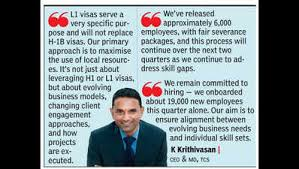
- TCS CEO K. Krithivasan has publicly said TCS will not hire new H-1B applicants and will instead expand its local U.S. workforce base.
- Moreover, many H-1B approvals are not fully deployed; TCS deploys fewer staff than the visa quota allows, reflecting rising caution.
This combination of external pressure and internal risk makes doubling down on local hiring look like a safer, more sustainable path.
Cost, Proximity & Client Expectations
Beyond policy, clients increasingly expect closer collaboration, cultural alignment, and shorter time zones. Building U.S.-based talent helps:
- Ease communication, reduce latency, and foster stronger client relationships.
- Mitigate the “body shopping” stigma, where firms are criticized for merely shuttling people across borders to fill seats.
- Offset hidden costs of visas, relocation, and compliance by tapping domestic labor markets.
Reskilling & Innovation Imperatives
The tech landscape is evolving fast — AI, cloud, cybersecurity, data engineering. Relying on generic offshore pools won’t cut it. So:
- TCS is emphasizing reskilling, upskilling, and building a diverse tech bench in U.S. locations.
- It is planting academic partnerships and local innovation hubs (e.g., Pace Ports, U.S. universities) to build talent from within.
- In geographies like Latin America, TCS already operates with very high local hiring percentages.
Key takeaway:
TCS’s shift is less about abandoning India and more about de-risking, aligning with client expectations, and evolving its global workforce model for the next tech wave.
2. The Strategy Unpacked: How TCS Plans to Hire Locally

No New H-1B, Select Renewals
The headline move is clear: TCS is not opening new H-1B slots. Existing visas may be renewed selectively, but the long-term direction is away from new entries.
“Rotation + Locals” Model
Historically, TCS rotated people from India on H-1Bs, then recalled them to send in fresh batches. Now:
- The rotations will be more careful and limited.
- Over time, locals will increasingly fill the roles that were earlier reserved for deputed staff.
Regional Talent Hubs & Nearshore Models
TCS will expand hiring not just in U.S. metros but also in nearshore geographies (Latin America, Caribbean, etc.). That mix gives flexibility and mitigates visa risk.
Academic & Community Tie-ups
To build grassroots pipelines:
- TCS is collaborating with U.S. universities (e.g., Carnegie Mellon, Cornell) to co-create talent and projects.
- In other locations (Australia being an example), TCS already recruits local graduates and interns.
- Its STEM push and community engagement programs support building local talent for the long haul.
Internal Reskilling & Redeployment
To smooth the transition, TCS is:
- Investing in AI-led learning pathways.
- Redeploying legacy employees (especially offshore) to new roles aligned with client demand.
- Strengthening assessment frameworks and skills mapping to locate role fit, not just domain fit.
Key takeaway:
TCS’s strategy combines visa constraints, local hiring, academic tie-ups, and reskilling — a multi-pronged approach rather than a single radical shift.
3. The Choppy Waters: Risks, Challenges & Critiques

Talent Shortage & Competition in U.S. Markets
Hiring high-skill tech talent in the U.S. is fiercely competitive. Salary expectations, cost of living, retention — all are challenges. TCS must contend with established firms, startups, and tech giants.
Displacement Concerns & Political Sensitivities
U.S. legislators are watching. TCS has already been asked by U.S. senators to explain potential displacement of American workers.
The optics must be carefully managed.
Cost Pressures
Local U.S. salaries, benefits, tax compliance, facilities — these costs are far higher than in India or other low-cost locations. The margin structure will be under pressure, especially in price-sensitive engagements.
Organizational Change, Culture, and Transition
Shifting a huge global workforce model is a mammoth culture task:
- Offshore teams may feel sidelined or demoted.
- For employees in India, role transitions need clarity.
- Communication across time zones, evaluation frameworks, and HR policies must evolve.
Dependency on Renewals & Existing H-1B Pool
Though TCS is not seeking new H-1B hires, maintaining continuity for existing visas is essential. Any renewal or amendment restrictions can trip operations.
4. What’s in It for India — and Indian Tech Talent?
This shift may unsettle some assumptions, but it also opens opportunities.
Upskilling & Premium Roles
As TCS pivots, the demand in India may tilt further toward higher value, specialized roles — AI, cloud, data science, cybersecurity, generative AI. Less arbitrage, more depth.
Global Project Ownership
With fewer people deployed on-site, project delivery models may change. India-base teams will need to carry more responsibility, decision-making, and ownership.
Talent Flow Changes
Expect more reverse flow (U.S. or nearshore talent moving to India) or hybrid collaboration models. Bench and talent management will need agility.
Intensified Competition
If U.S. markets thrive, many Indian firms may follow suit, resulting in war for high-skill talent in India too. Lateral moves, premium hiring, upskilling will accelerate.
Key takeaway:
For Indian tech professionals, this is a wake-up call: strategic upskilling, flexibility, and owning domain depth will be more important than volume-based skills.
5. What Should Tech Professionals Do Now?
For Indian Tech Professionals
- Embrace lifelong learning. Focus on AI, cloud native, security, generative AI, domain knowledge (finance, healthcare, etc.).
- Build international exposure. Remote U.S. projects, collaboration, open source contributions.
- Cultivate soft skills. Communication, adaptability, client-facing sensibility.
For U.S.-Based Professionals
- Watch for new opportunities. Firms like TCS seeking local talent will open new roles across cities.
- Check for parity. If hired by a formerly offshore-centric firm, ensure you understand compensation, growth path, benefits.
- Engage early. Join talent networks, university tie-ups, events where TCS or its vendors are active.
For Students & New Graduates
- Focus on portfolio, internships, industry projects — not just degrees.
- Target companies that engage at the campus level or through local chapters — firms now recruiting locally, not just via global pipelines.
6. What This Means for the Global Tech Landscape
Beyond India & TCS
Other Indian tech firms (Infosys, Wipro, HCL, Cognizant) are watching closely. Many are already increasing U.S. hiring.
Rise of Nearshoring
Nearshore models (Latin America, Eastern Europe) will get more traction. Lower risk of visa issues, closer time zones, cultural affinity.
Efficiency over Scale
The era of brute-force sourcing is giving way to lean, high-value models. Quality, domain depth, client intimacy will trump mass delivery.
Resilience Against Policy Shifts
Firms with strong local talent presence are more resilient to changing visa regimes, taxation changes, or geopolitical barriers.
H3 Summary:
TCS’s pivot may be the inflection point that accelerates the evolution of how global IT delivery is done — from scale to specialization, from offshoring to local sourcing and client intimacy.
Final Thoughts & Call to Action
TCS’s decision to halt new H-1B hiring in favor of local U.S. talent may feel like a seismic change — but it’s also a natural progression. The winds of technology, regulation, client expectation, and talent strategy are converging. For tech professionals in India and around the globe, the message is clear: evolve or risk obsolescence.