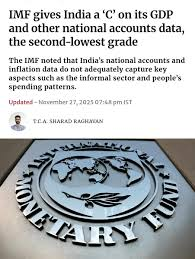
IMF gives India’s GDP data a ‘C’ grade, citing outdated base years and methodological gaps. Here’s what the rating means for economic accuracy and policy.
Have you ever wondered how trustworthy the numbers are behind headlines like “India’s GDP grows 7.8%” or “Economy doubles in a decade”? What if I told you — even as the economy zooms ahead — the very data we depend on to understand it is under scrutiny? That’s exactly what happened recently, when the IMF gave India’s national accounts statistics — including GDP and GVA — a ‘C’ grade.
Yes, a country claiming to be the world’s fastest-growing major economy is being told by a global watchdog: “Your data has shortcomings that hamper proper surveillance.” That should make us pause and ask: Is our economic growth real? Or does it ride on shaky accounting?
In this article, I walk you through what this IMF rating really means — for policymakers, analysts, and everyday citizens like you and me. Think of it as a transparency check before we celebrate growth headlines.
What Did IMF Say — And What is the ‘C’ Grade All About?
The Report Card: Understanding IMF’s Rating
Every year, the IMF reviews data quality from countries under what’s called the Article IV Consultation. In its 2025 edition, India’s national accounts — the numbers that underpin GDP, GVA, and other economic data — were given a ‘C’ grade. That’s the second-lowest grade in their scale. IMF+2IMF+2
- The IMF said data frequency and timeliness are “adequate” and granularity is “broadly adequate.” News Minimalist+2IMF+2
- Yet, methodological weaknesses — in deflators, outdated base year, and lack of certain price indices — “somewhat hamper surveillance.” IMF
- As a result, even though numbers like GDP growth might look robust (6.5% in FY24/25) The Financial Express+1 — the IMF says they should be taken with a grain of salt.
Put simply: the data is collected regularly, but the foundations are shaky.
Why This Matters
If the data measuring the economy is weak, the consequences ripple across everything — from policymaking and investor decisions to daily lived reality.
- Budgets, stimulus plans, or reforms rely on GDP estimates — flawed data can lead to overconfidence or missteps.
- Investors and analysts use GDP and inflation to judge sectors or stocks — unreliable numbers can distort valuations.
- Citizens often take growth numbers as proof of progress; misreporting can mask real challenges like joblessness, inflation, or regional inequality.
In short: if the measuring tape is stretched, the results don’t reflect reality — and that’s dangerous.
Major Issues IMF Highlighted: What’s Wrong With the Data
The IMF didn’t mince words. Here are the specific problems it pointed out — in plain English.
1. Outdated Base Year & Deflator Problems
- India still uses 2011–12 as the base year for GDP calculations — both for national accounts and CPI. IMF+1
- Price adjustments (deflators) rely heavily on wholesale price index (WPI) due to absence of a full Producer Price Index (PPI). News Minimalist+1
- This matters because when base-year prices and inflation measures are outdated, real growth estimates get distorted — what looks like growth might sometimes be inflation or price distortions.
2. GDP Measurement Methods Don’t Match — Production vs Expenditure Approaches
GDP in India can be calculated using two approaches:
- Production (Output) approach: Add up value of goods and services produced.
- Expenditure approach: Sum up consumption + investment + government spending + exports minus imports.
IMF flagged “sizable discrepancies” between these two methods in India’s data — a red flag. News Minimalist+1
Why it matters: If two credible methods yield different numbers, reliability drops. It also hints at gaps in capturing informal sector, or under-reporting in one method.
3. Lack of Seasonal Adjustment and Granularity
- India does not regularly publish seasonally adjusted quarterly data — which helps account for fluctuations (festivals, monsoons, harvests). News Minimalist+1
- Data like Gross Fixed Capital Formation (GFCF) by institutional sector — giving insights into who is investing — is published with significant lag, reducing its analytical utility. News Minimalist+1
- In short: even when data exists, it’s often too coarse or outdated to reveal nuanced trends.
4. CPI (Inflation) Data Also on Wobbly Ground
While inflation is tracked monthly, IMF rated India’s CPI data a “B” — indicating it’s broadly adequate but flawed. Reason: outdated basket of goods, old weights, and base year issues. News Minimalist
In a fast-changing economy, where consumption patterns shift rapidly, this matters — what we spend and how we spend changes, but CPI may not capture that accurately.
5. Gaps in Other Statistical Domains
Beyond GDP and inflation, IMF highlighted issues with:
- Government finance statistics — consolidated data across central, state, and local governments has not been updated comprehensively since 2019. News Minimalist+1
- External sector statistics: while coverage and frequency are “adequate,” granularity and consistency — especially for non-banking financial companies (NBFCs), households, and financial interconnectedness — need improvement. News Minimalist+1
These gaps limit ability to evaluate fiscal health, external debt, and systemic financial risk properly.
What India Is Doing — And What’s Expected Soon
Luckily, the story doesn’t end with criticism. According to the IMF report, India is already working on reforms to tackle these data issues. IMF+1
✅ Workstreams Underway
- Updating GDP and CPI base years — expected by early to mid-2026. This should reflect more recent consumption and production patterns. News Minimalist+1
- Improving statistical techniques — better deflation methodology, possibly adoption of a robust Producer Price Index (PPI), and dual deflation rather than single deflation. IMF+1
- Broader data coverage — efforts to better incorporate informal sector activities, smaller enterprises, and non-corporate segments that remain under-represented. IMF+1
🕓 What to Watch Out For
The full benefits from these reforms won’t be immediate. Even after base-year updates, data coverage, lag, and granularity will take time to improve. For at least a couple of years, analysts and citizens will likely be dealing with transition data — partly old methodology, partly new. That means some volatility and confusion in growth or inflation stats during the shift.
The Real-World Impact: Why This Data Quality Issue Isn’t Just Academic
Let me break down what this IMF verdict means — for you, for businesses, and for the country.
📊 For Policymakers & Governance
- Budget and fiscal policy: Governments often rely on GDP and GVA numbers to plan budgets, subsidies, and public investment. If data overstates growth or investment, policy might overshoot or misallocate resources.
- Monetary policy: Inflation data and GDP impact interest rate decisions. Flawed CPI or GDP deflator can mislead the central bank.
- Social welfare and regional planning: If the informal sector isn’t captured well, actual employment or output — especially in rural areas — remains hidden. That means many policies may overlook large populations.
🏦 For Investors, Businesses, and Economists
- Valuation and investment decisions: Large firms or investors use GDP growth, consumption data, and inflation as inputs for sectoral demand, business prospects, and valuations. If data is shaky — every model built on it becomes risky.
- Forecasting & risk analysis: Economic projections, stress tests, macro analysis — all rely on baseline data. Weak data means higher uncertainty.
- Global credibility: Institutional investors, global indices, foreign fund managers look at data quality before investing. A “C” grade may dent confidence, or demand a risk premium for Indian assets.
🚶♂️ For Everyday Citizens
- Perception vs Reality: Growth claimed at 7–8% may not reflect ground realities like unemployment, inflation, or wage stagnation — especially if informal economy is undercounted.
- Inflation and cost-of-living mismatch: If CPI basket is outdated, real inflation faced by households might be much higher. That hits purchasing power, savings, and living standards.
- Policy misalignment: Welfare, subsidies, and social programs based on flawed data can end up missing the needy — especially in rural or informal sectors.
Why Data Transparency Should Be as Important as Growth Numbers
In many ways, data is the backbone of a mature economy — think of it as the measuring tape. If the tape is stretched or skewed, even accurate measurement becomes illusionary. That’s why data transparency and periodic updates matter.
Here’s a simple analogy:
Building a house with plans based on outdated measurements. The blueprint looks good on paper, but once you lay the bricks, things don’t fit. You may complete the house — but it will crack under pressure, or never serve the intended purpose.
Similarly, an economy may “grow” on paper, but if data doesn’t reflect real output, inflation, employment, and demand — cracks appear in real life: joblessness, inequality, price shocks, social distress.
That’s why we should treat the IMF’s “C” grade as less of a reprimand, and more of a stern reminder: Growth without credible data is a house built on sand.
What You Should Do — As a Citizen, Analyst or Investor
If you care about Indian economy, or just want to protect your own financial future, here are practical steps:
- Look beyond headline GDP numbers
- Observe real-world indicators — job growth, demand, consumption, price of staples — not just growth rates.
- Track data from alternate sources: credit growth, power consumption, rural consumption surveys, household surveys.
- Demand transparency and timely updates
- Public discourse should push for base-year update, PPI adoption, and seasonal adjustments.
- Encourage researchers, journalists, and economists to critique data rather than take it at face value.
- Invest and plan with caution
- Use buffer or margin of safety if your model depends heavily on macro-data. Consider scenarios: what if growth is overestimated by 1–2%?
- Factor in data lag — don’t assume current numbers tell full story.
- Support informal economy inclusion
- Seek policies that recognize informal sector: skill mapping, regional data surveys, more frequent updates.
- For businesses targeting rural or informal sectors — understand data limitations, do grassroots research.
- Watch for upcoming 2026 data overhaul
- The government plans to release updated GDP and CPI base-year series in early to mid-2026. IMF+1
- Be ready for revisions — and treat 2026 data as a fresh baseline rather than continuation.
Final Thoughts: Data Integrity Is the Real Growth You Should Demand
India is riding a strong growth wave — with IMF projecting ~6.6% GDP growth in 2025–26 and continuing optimism about its economic trajectory. IMF+2The Financial Express+2
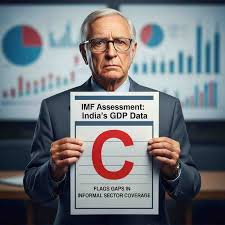
But growth supported by shaky data is like a dam built on weak soil — it looks sturdy until pressure hits. The IMF’s “C” grade isn’t a sign that India can’t grow; it’s a warning that without credible numbers, good governance, transparency and reforms, even the strongest growth may lose meaning.
For a country aspiring to become a $5–6 trillion economy by 2030, this is not the time to ignore the foundation. Real success will come when our numbers match our lived reality — for the farmer, the small business, the migrant worker, the salaried employee, and every Indian whose life depends on stable growth, fair prices, and honest data.
“Numbers matter. Not because they’re shiny. But because lives, livelihoods, and trust hinge on them.”
— Your friendly economy watcher
So the next time someone quotes GDP growth or inflation numbers — ask: “Under which base year? What methodology? How recent is the data?” That’s not cynicism, it’s responsible citizenship.
CTA
Do you follow India’s economic numbers closely — like GDP, inflation or employment data?
What’s your take: Are the numbers real — or are we chasing a statistical mirage?
Drop your view below, and let’s discuss how we can build a more transparent, trustworthy economic data culture for India.