Hidden forests vanish while laws lag behind. Why India’s forest protection is failing—and what can be done today.
Picture a lush patch of trees, animals, undergrowth—all thriving in a corner of the state. One day, bulldozers arrive. The forest vanishes. But here’s the twist: in government records, it never existed.
That’s not fantasy. In India today, many forests are unrecorded, unclassified, or unprotected by law. They are “buried” in plain sight—because the legal machinery, mapping, and policymaking aren’t keeping up.

This paradox—buried forest, missing law—is at the heart of a serious crisis. While deforestation continues, legal protections lag, allowing developers to exploit loopholes and forests to slip through the legal cracks.
In this article, I’ll walk you through:
- Why some forests remain invisible to the laws
- Key legal gaps and recent amendments
- Real cases showing how forests vanish off the books
- What needs to change (with examples, proposals, and a call to action)
Let’s bring hidden forests into light.
1. The Problem: Forests That Don’t Exist Legally
1.1 “Not on the books”: the phenomenon of legal invisibility
When I say “buried forest,” I mean places that:
- Are ecologically forested or natural tree cover
- But are not classified or notified as “forest land” in legal records
- Therefore miss out on statutory protections, approvals, oversight
Because legal records and definitions matter a lot (e.g. “forest land” vs “non-forest”), forests that aren’t in official registers can be cleared with minimal hurdles, or disguised as non-forest land and converted.
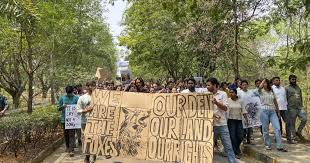
A stark example: Kancha Gachibowli in Hyderabad. Bulldozers felled large swathes of trees for development. But that patch did not show up in forest records. So although it was ecologically rich, it lacked legal cover.
In many parts of India, forest cover surveys and satellite data show decline — but the “annual forest reports” sometimes claim net gains. The discrepancy often arises because some lost forests were never recorded as forest in legal classification or maps.
H3 takeaway: Legal invisibility lets forest cover vanish in practice, even if satellites see green.
1.2 Why these gaps exist
Several structural reasons contribute:
- Old maps & colonial legacy: Forest maps drawn decades ago may be outdated, or large patches were never mapped.
- State vs central records mismatch: Forest delineation lies partly with state governments. If state records never notified a land as forest, central law may not recognize it.
- Ambiguous land classification: Some lands are “wasteland,” “revenue land,” or “village commons” even though they are wooded.
- Lack of real-time updating: Forest boundaries shift (due to encroachment or regrowth), but records seldom keep up.
- Legal redefinitions & weak amendments: Recent changes to forest law and regulatory rules have diluted prior protections, further weakening the safety net.
In short: the legal machinery is behind ground reality.
2. Legal Gaps & Loopholes: The Law Is Missing Where the Forest Should Be
To understand how “missing law” plays out, let’s examine legal frameworks, recent amendments, and gray zones.
2.1 Foundation laws: Forest (Conservation) Act & Indian Forest Act
Forest (Conservation) Act, 1980
This is India’s key law to restrict the diversion (i.e. conversion) of forest land for non-forest purposes. It mandates central approval before state governments can allow forest land to be used for projects.
However:
- It applies only to land already recognised as forest in state records, so unrecognized patches may escape its scope.
- States sometimes argue certain areas were never forest land in records, hence not subject to the Act.
Indian Forest Act, 1927
This colonial-era act gives power to state governments to declare reserved forests, protected forests, etc., and penalize offenses.
But again, its protections apply where maps and declarations have been made. Forests without those notifications often lie outside its legal reach.
2.2 Recent amendments & weakening of protections
India in 2023 introduced amendments via Van (Protection & Development) Rules 2023 / Forest Conservation (Amendment) Act 2023. Activists warn these changes could open up large forest land to development.
Key criticisms include:
- Removal or dilution of Gram Sabha consent requirement. Forest-dwelling communities’ consent is less mandated.
- More flexibility given to state governments to convert or de-notify forest land for “strategic” projects or development without stringent checks.
- Procedural relaxations or lesser penalties for offenses.
- Some argue these changes codify de facto creeping liberalization already happening.
Thus, the legal net shrinks just when forest threats grow.
2.3 Community forest rights & their weak performance
The Forest Rights Act (FRA), 2006 was a pioneering law recognizing Community Forest Resource rights (CFR) and individual rights of forest dwellers.
But in practice:
- Implementation has been slow. Many CFR claims remain unresolved in states.
- Design gaps and ambiguity leave communities uncertain about managing forests.
- When forest land conversion is proposed, communities’ rights don’t always stop legal approval—even under FRA mandates.
In places where forests are never recognized legally, the FRA’s safeguards may not apply in the first place.
2.4 The “forest-like” lands & mapping exceptions
States classify “forest” lands differently. Some classify lands as “forest-like,” “scrub,” or “wooded non-forest.” These categories often lack full legal protection, though they provide ecological services.
In Haryana, for instance, mapping efforts are underway to identify “forest-like” patches, but the new definitions (minimum area, canopy density) may exclude many real wooded patches.
In sum: missing law arises not just from lack of law, but from how laws treat or exclude certain lands.
H3 summary: Legal frameworks, though present, have major blind spots—forests not in records, weakened amendments, slow community rights, and ambiguous classifications all erode protection.
3. Real-World Illustrations: How Forests Disappear Off the Map
Let’s move beyond theory and look at how this plays out in actual cases.
3.1 Kancha Gachibowli, Hyderabad (Telangana)
This is a vivid recent example. Bulldozers cleared a forested tract near the University of Hyderabad. The land—a habitat for many species—was publicly greened until then. But in legal records, its forest status was not recognized, which delayed protective action.
People protested, courts intervened, and the clearance was halted. But the damage and gap in legal recognition were stark reminders: forests that are ecologically vital but not legally recognized can be under siege.
3.2 Discrepancies in forest surveys vs ground reality
The India State of Forests Report (ISFR) claims periodic increases in forest and tree cover. Yet independent satellite data and field reports often reveal forest loss in patches. Dialogue Earth, for example, noted that between 2021 and 2023, about 4,270 km² of tree canopy was lost in Auroville — but ISFR reported a net increase.
Why does this happen? Many of the lost patches were not legally classified as forest earlier, hence their depletion does not count in official tallies. They were “invisible losses.”
3.3 Artifact of classification in Haryana’s Aravalis
Parts of the Aravali hills in Haryana are ecologically forested and biodiverse. But in many cases, these lands are not classified as forest, making them vulnerable to encroachment, illicit mining, or conversion. The new forest-like mapping is a double-edged sword: while it attempts to bring recognition, narrow definitions risk excluding many patches.
3.4 Recent tree felling and enforcement gaps
In Mohali (Punjab), DFOs reported that 1,855 trees were cut without permission on land that is not classified as forest land. Because it lay outside legal forest boundaries, the department argued its jurisdiction was limited. The cost estimate of the felled trees was ~₹69 lakh.
Meanwhile, in Delhi, a Residents’ Welfare Association (RWA) felled 17 trees illegally in an urban area. The National Green Tribunal (NGT) ordered fines and compensatory planting—but pointed out that no strong legal precedent existed to support heavy per-tree penalties under existing tree laws. The Times of India
These cases show how forests and trees outside formal classifications are often in legal limbo.
H3 summary: On-the-ground cases—from Hyderabad to Mohali—expose the tragic gap: forests vanish legally because the law never recognized them in the first place.
4. Why This Matters: Ecological, Social & Legal Stakes
This isn’t just academic. The disappearing “invisible forests” carry real costs—to environment, communities, and climate.
4.1 Ecological loss & climate impact
- Tree cover loss affects biodiversity corridors, species movement, microclimates, soil health, and water retention.
- Carbon capture and climate mitigation suffer — losing forests, even small patches, reduces carbon sequestration potential.
- Fragmentation of forest habitats amplifies stress on wildlife.
4.2 Community & tribal rights at risk
When forests aren’t recognized legally:
- Local communities lose access to resource rights, customary use, and forest-based livelihoods.
- Their voices are weakened in decision-making on land use or forest diversion.
- Conflicts rise: if government or developers claim land (since it’s “non-forest” legally), communities may be displaced or denied protection.
4.3 Implications for law, governance, and justice
- It undermines accountability: if forest loss is “off the books,” legal action or oversight becomes difficult.
- Environmental justice suffers: marginalized groups are less able to challenge deforestation when laws don’t apply.
- It erodes trust: citizens see green cover vanish, legal systems lag, and protection promises fade.
H3 summary: Losing invisible forests undermines ecology, community rights, and the very idea of environmental justice.
5. What Must Be Done: Legal, Policy & Citizen Steps
Fixing the “missing law” problem requires multi-pronged action. Here’s a roadmap:
5.1 Legal mapping & retroactive classification
- Nationwide audit to identify forested lands that are not in legal records.
- Retro-notification powers: states should be empowered to classify or reclassify lands as forest where ecological criteria are met.
- Automatic inclusion of “forest-like” lands into protective status, especially those with canopy density or ecological importance.
5.2 Strengthening legal protections & oversight
- Reverse or revisit amendments that weaken accountability (e.g. reinstating Gram Sabha consent for forest diversion).
- Tighten rules for conversion of forest land—even if newly notified.
- Make penalties stronger, and enforcement swifter.
5.3 Empower community forest rights meaningfully
- Accelerate the settlement of Community Forest Resource claims under FRA, with proper mapping, training, and oversight.
- Ensure that communities are real partners in forest governance, not passive bystanders.
- Use customary knowledge + scientific management to regenerate forests.
5.4 Better integration of data, tech & public platforms
- Link forest dashboards, remote sensing, GIS, and legal records so that forest status updates automatically.
- Public portals, open data, and citizen mapping initiatives can help check government records.
- Use AI / satellite-based alerts when forests shrink in unrecognized zones.
5.5 Judicial activism & strategic litigation
- Courts must insist that legal recognition catch up to ecological reality.
- Public interest litigation can challenge states that allow forests to be cleared where classification is missing.
- Tribunals like NGT should demand accountability for trees felled in “non-forest” land when ecological evidence suggests forest status.
5.6 Political, administrative & budgetary will
- States and central government must allocate funds to mapping, classification, enforcement, and rehabilitation.
- Forest departments should be retooled and resourced—not just with patrol teams, but data units and outreach units.
- Elected representatives must be educated to resist short-term gains from forest land conversion.
H3 summary: The solution lies in legal reform, community rights, data linkage, judicial backing, and political will—together closing the gap between forest reality and forest law.
✅ Final Thoughts & Takeaway
The phrase “buried forest, missing law” captures a profound crisis: forests vanish not just from land but from legal memory. When our laws are blind to forest existence, they become powerless to protect what matters most.
Yet there’s hope. As satellite data improves, communities strengthen, and legal activism intensifies, we can begin to restore that missing legal layer—bringing invisible forests back into law’s embrace.
If you care about forests, you can begin today: map your area, check forest notification maps, support local forest rights groups, and demand that law keep pace with nature.
Let me leave you with a question: Is there a patch of green near you that seems alive but isn’t in records? Maybe it’s time to make it visible—on paper, in law, and in justice.