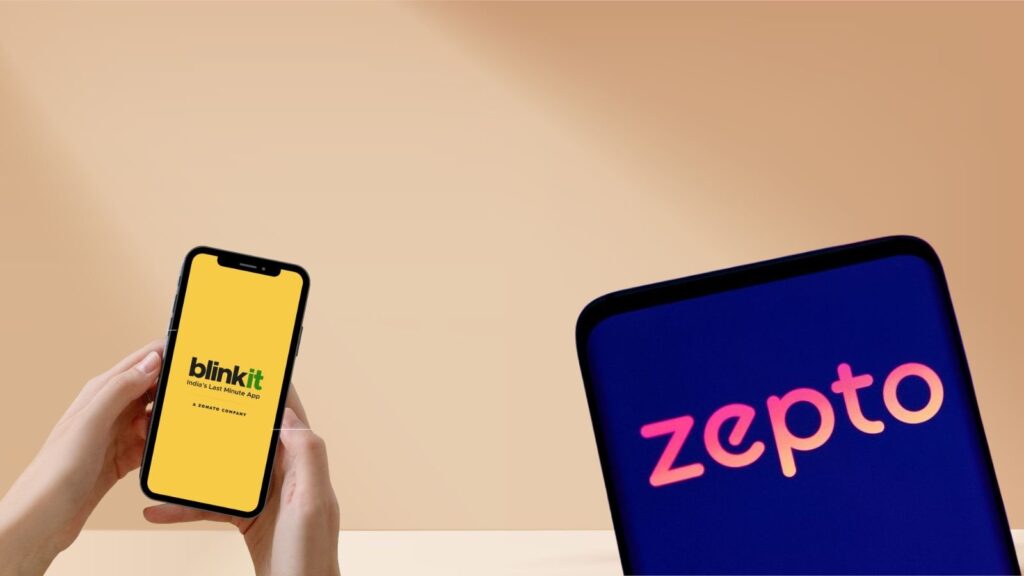
India’s Quick Commerce Race: Blinkit’s Rising Dominance
India’s quick commerce race appears to be entering a decisive phase. According to Goldman Sachs, Blinkit is no longer just leading the sector — it is on track to entrench its dominance, potentially controlling close to half of the market over the medium term.
Market Share and Leadership
Goldman Sachs estimates Blinkit currently holds 40–45% market share of India’s quick commerce industry, a position it expects to remain largely intact through fiscal 2030E. The brokerage in its report said it sees Blinkit’s leadership as structural rather than cyclical, underpinned by scale, infrastructure density and improving unit economics.
Blinkit already controls more than 50% of India’s 6,000+ dark stores, giving it a decisive edge in delivery speed, order density and fulfilment costs. In a business where proximity and scale drive margins, this footprint advantage is difficult to replicate. For more on how dark stores in e-commerce are changing the game, read our in-depth analysis.
Profitability and Market Evolution
Goldman expects quick commerce to evolve into more than a two-player market, but not a fragmented one. Its base case assumes Blinkit retains a 40–45% share, two other players hold 15–29% each, and one or two sub-scale players operate on the margins.
While market share distribution may still look competitive on paper, profitability tells a far more lopsided story. Goldman expects Blinkit to command more than 100% of the industry’s Ebitda profit pool starting fiscal 2027E, and to sustain this position for at least the following two to three years.
This implies that Blinkit could be profitable while the rest of the industry continues to incur losses. To understand more about Ebitda and profitability in the context of Indian startups, visit our detailed guide.
Consolidation and Challenges for Rivals
At present, seven players operate in India’s quick commerce space — Blinkit, Swiggy Instamart, Zepto, JioMart, BigBasket, Amazon and Flipkart. However, Goldman’s framework points to inevitable consolidation.
Swiggy and Zepto remain the most credible challengers, but the widening gap in store density and contribution margins puts increasing pressure on smaller or less focused players. Global platforms such as Amazon and Flipkart may participate selectively, but are unlikely to prioritise quick commerce profitability in the near term.
For an in-depth look at India’s quick commerce market, including trends and future outlook, check out our comprehensive report.
Zepto’s Challenge and the Path Forward
This brings the spotlight firmly onto Zepto. If Blinkit continues to consolidate market share while capturing the profit pool, the risk for challengers is not immediate failure but gradual marginalisation — a trajectory reminiscent of Snapdeal’s decline in Indian e-commerce.
Zepto still has meaningful scale and brand recall. However, sustaining relevance in a market where one player controls half the infrastructure and most of the profits will require either sustained capital deployment or a clear strategic differentiation.
Investors looking to navigate the Indian startup ecosystem and make informed decisions can find valuable insights and analysis on our platform.
Conclusion and Investor Outlook
In conclusion, Blinkit’s dominance in the quick commerce space poses significant challenges for rivals like Zepto. As the market continues to evolve, investors must stay informed about the latest developments and trends. For the latest stock market news and updates, keep visiting our website.