Did You Check Your Portfolio This Morning?
You open your trading app — Sensex is surging, Nifty is touching new highs, optimism is in the air. A few hours later, you see red — indices slide, some stocks drop, and the mood sours. Sounds familiar? That’s exactly what happened in the latest session when Indian markets swung wildly: record highs in the morning, followed by sharp profit-booking by noon.

If you’re an investor — long-term or short-term — today’s “Stock market news today” serves as a reminder: markets reward optimism, but they also punish over-eagerness. Understanding the forces behind these swings can help you stay calm, make smarter decisions, and avoid panic trades. Let’s break down what moved the markets, why money rotated across sectors, and what to watch next.
📈 Morning Euphoria: What Sparked The Rally?
New Life for Fading Optimism
When markets opened, the rally felt like déjà vu: after recent sluggish sessions, investors seemed ready to ride on renewed hope. Fresh buying, some optimism about upcoming macro-data — and perhaps a sense that “the dip” had been overdone — gave the markets a push.
- Sensex jumped by ~450 points early on — a sharp move that brought it to 86,159.02.
- Nifty climbed toward 26,325.80, beating recent highs.
The early momentum seemed fueled by confidence, a rush of money, and perhaps a feeling of “now or never” before year-end.
Summary: Early rallies often reflect a mix of fresh money entering and traders betting on short-term gains — a fragile moment that can reverse quickly.
Broad Optimism,—but Not Uniform
While the indices soared, not all sectors joined the party. Gains were more concentrated, and not all stocks participated equally:
- Some bank and select blue-chips rode the wave.
- Many midcaps or smaller stocks stayed quiet.
- Broad indices rose, but underlying breadth didn’t explode — a subtle signal to stay alert.
Summary: A market rally built on selective buying and narrow participation can be vulnerable to profit-taking — especially if global cues or liquidity change.
⚖️ Midday Reality Check: Pullback, Profit Booking & Macro Worries
Profit Booking Hits Hard — The Classic Tug-of-War
By noon, the exuberance faded. Stocks that surged early began to slip, and many investors locked in gains, especially in high-valuation names or recent outperformers. The result:
- Sensex lost up to 600 points from its day’s high, sliding to 85,556.80.
- Nifty dipped below 26,150, hitting 26,148.95.
- Market breadth turned negative: more stocks fell than rose.
Profit-booking — a phenomenon as old as markets themselves — reminded everyone: not all rallies survive contact with reality.
Summary: Rapid gains often invite profit-booking as investors lock in gains; the higher the rally, the harder the landing — especially without fresh catalysts.
Broader Pressures — Rupee, Global Markets, and FII Outflows
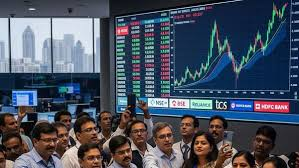
Profit-booking was just one part of the story. Multiple macro factors conspired to sap confidence:
- Rupee weakness: The rupee slipped to record lows, denting foreign-owned assets and raising fears of higher import costs.
- Global cues: Asian and global markets were jittery — risk-off sentiment hit emerging economies like India harder.
- Foreign Investors (FIIs) pulling out: Continued foreign capital outflows added to selling pressure.
- Rising bond yields / Mixed macro outlook: Interest-rate expectations and inflation concerns clouded the horizon for rate-sensitive sectors.
Summary: When currency weakness, global uncertainty, and foreign outflows coincide, even promising domestic fundamentals may not hold up equity markets.
🔎 What This Means for Different Stakeholders
For Short-Term Traders: Watch the Tide, Not Just the Waves
If you trade frequently, today was a textbook “buy-on-hope, sell-on-fear” scenario:
- Good: fast rallies offer quick entries.
- Risk: abrupt reversals can wipe out gains — especially if positions are uncovered or leveraged.
Tip: Set realistic exit targets, keep stop-losses, and don’t get greedy after a big up-move.
For Long-Term Investors: Don’t Let Noise Distract You
If you’re investing for the long haul — retirement, wealth building, SIPs — remember:
- Day-to-day volatility is noise, not signal.
- Macro fundamentals (economy, corporate earnings, valuation) matter more than intraday swings.
- Volatility can offer buying opportunities if valuations become attractive.
Think of it like traffic in a storm: yes, you’ll get stuck — but if your destination is far, slow and steady works better than speeding.
For New or Occasional Investors: Don’t Follow Herd Without Context
Seeing headlines like “Markets crash ₹2 lakh crore” or “Sensex tanks 500 points” may feel scary — but don’t panic-sell out of fear.
Instead:
- Take a step back.
- Revisit why you invested.
- Consider whether the fundamentals have changed or just the sentiment.
Volatile days remind us: investing without plan = gambling.
💡 Key Lessons from the Session
- Strong rallies don’t always last — profit-booking can hit fast when participants get impatient.
- Macro factors matter — currency, foreign flows, global markets, interest-rate expectations all impact domestic equities.
- Breadth over headline — a narrow rally can collapse faster than a broad-based one.
- Investor psychology rules — fear and greed still drive markets, sometimes more than fundamentals.
- Preparedness wins — use volatility as an opportunity, not a panic trigger.
✅ Final Thoughts: Volatility Is Real — But So Is Opportunity
Today’s “Stock market news today” highlights a key truth: markets are not always rational. They follow waves of sentiment, emotion, and external events. But volatility doesn’t mean doom. For informed investors — who know why they invest and where they stand — every dip can be an opportunity.
So next time the Sensex dips or Nifty oscillates wildly, take a deep breath. Re-read your investment plan. And remember — in the world of stocks, patience often beats panic.