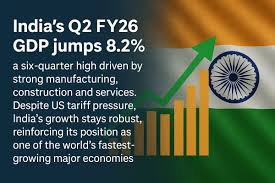
India’s Q2 FY26 GDP rose 8.2%, a six-quarter high — discover what’s driving this growth, what it means for investments, jobs, and everyday Indians.
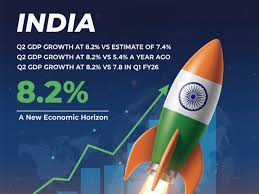
What if I told you that even after global headwinds, tariff tensions, and tough comparisons — India’s economy just recorded one of its strongest quarters in over a year? Yes, for Q2 FY26, the official growth figure came in at a robust 8.2%, the highest in six quarters. For ordinary Indians — job-seekers, salaried professionals, small-business owners, first-time investors — this number isn’t just a macroeconomic headline. It’s a hint at what could be coming: more jobs, better consumer demand, and potentially stronger markets. If you’ve ever wondered, “Is now a good time to invest or stay confident about the economy?” — this GDP print might just make you believe it’s worth another look.
India Q2 GDP
📈 What’s Behind the 8.2% Surge? A Deep Dive
Real GDP vs. Nominal GDP — What’s the Difference?
Before we dig into the drivers, a quick primer. Economists talk about two types of GDP:
- Real GDP — measures output after adjusting for inflation. It shows how much actual production and services have grown. ()
- Nominal GDP — measures output including price changes. If inflation is high, nominal GDP looks larger even if output hasn’t grown much. ()
In Q2 FY26, India’s real GDP rose by 8.2%, significantly higher than 5.6% in Q2 last year. () Meanwhile, nominal GDP grew by ~8.7%, suggesting inflation is modest and real demand is driving growth rather than price spirals. ()
Summary: Real GDP growth shows actual expansion in output and services — 8.2% signals a genuine growth spurt, not a price-fuelled illusion.
What’s Fueling the Growth Engine — Sectoral Breakdown
🏭 Manufacturing & Construction: Industry Back More Than Just a Promise
- Manufacturing grew by 9.1% — a clear statement that factories, goods production, and industrial supply chains are moving fast again. ()
- Construction rose by 7.2%, reflecting strong real estate, infrastructure pull, and likely public and private capex in roads, housing, and commercial realty. ()
- Together, the secondary sector (industry + construction) clocked ~8.1% growth. ()
This is important because manufacturing + construction are often the most sensitive to demand cycles — when they revive, it typically signals broad-based momentum, not just temporary bursts.
💼 Services & Consumption: India’s Resilience Shines Through
- The tertiary/services sector — including finance, real estate, professional services — grew an impressive ~9–10%. ()
- Private consumption expenditure rose by about 7.9%, reflecting stronger consumer demand across urban and rural India. ()
For many Indians, this translates to better sales for small businesses, more hiring, and improved buying power — perhaps a new smartphone, that long-postponed home appliance upgrade, or even just getting out more often.
🌾 Agriculture & Utilities: Slow but Steady
Agriculture and allied sectors saw modest growth (~3.5%), while utilities (electricity, water, etc.) also grew at a slower rate compared to industry and services. ()
But this slowdown is not alarming — it’s in line with structural shifts favoring services and manufacturing, rather than agriculture-led growth.
Summary: The rally isn’t limited to one corner; manufacturing revival, services boom, and healthy consumption together signal a broad-based growth engine — a sign that India’s growth could be more sustainable than many think.
Why Investors, Markets, and Everyday Indians Should Care
1. Robust Domestic Demand = More Jobs & Income
Consumption and services growth often translate to job creation. Retail, real estate, services — these are employment-dense sectors. With nearly 8% growth in consumption, we could see better hiring and increased real incomes soon.
2. Industrial Recovery Could Fuel Capex & Infrastructure Growth
Strong manufacturing and construction growth can lead to more capital expenditure — think factories, roads, warehouses. This not only lifts GDP but creates infrastructure, supply-chain resilience, and supports long-term economic growth.
3. Supporting Equity Markets — But With a Caveat
Earnings growth across sectors might boost stock markets, especially large-cap indices such as Sensex and Nifty 50. Many analysts see a 3–5% upside for these indices by year-end. ()
But — mid- and small-caps may lag due to elevated valuations and liquidity constraints, thanks to a flood of IPO activity soaking up retail capital. ()
Summary: Strong GDP growth improves fundamentals for growth, jobs, and markets — but not uniformly. Large-caps and sectors tied to consumption, infrastructure, or manufacturing may benefit more than speculative, small-cap bets.
Risks & What to Watch — Why 8.2% Is Great but Not a Guaranteed Party
📉 Nominal GDP Growth Remains Tepid
Though real GDP rose, nominal growth (8.7%) remains moderate — lower than government’s fiscal-year expectations. ()
Why this matters: Lower nominal growth can compress tax revenues, potentially affecting government spending, welfare schemes, and fiscal balance. ()
🎯 Base Effects and Deflator Benefits — Not All Momentum Is Organic
Part of the surge is aided by a favourable base (comparison to weak prior quarters) and a soft GDP deflator (i.e., modest inflation). ()
If inflation picks up or global headwinds intensify, real growth may cool faster than expectations.
🌐 External Risks: Trade Headwinds, Global Uncertainties
Recent US tariffs on Indian exports could hit manufacturing and export-oriented sectors in coming quarters. ()
If global demand softens further — due to geopolitical tensions, currency swings, or supply-chain pressures — export-heavy or commodity-linked businesses may feel the pinch.
🏦 Monetary Policy Uncertainty
Strong GDP numbers may reduce the likelihood of imminent interest-rate cuts by Reserve Bank of India (RBI). ()
That could make borrowing costlier, impacting home loans, business investments, and liquidity — which in turn might weigh on demand and growth.
Summary: The growth spike is heartening, but structural challenges — weak nominal growth, global uncertainties, tight liquidity — suggest we should enjoy the momentum with eyes wide open.
What This Means in Everyday Life — For You, Your Job, and Your Wallet
- If you’re a salaried professional or job-seeker: Industries like services, real estate, manufacturing, and retail may open up more opportunities in the next 6–12 months.
- If you run a business or small firm: Rising demand and consumption could boost sales — but watch interest rates if you rely on credit.
- If you’re an investor: Large-cap, infrastructure, consumer-oriented, and manufacturing-linked companies might benefit more, while speculative bets may remain volatile.
- If you follow public policy or are a citizen: A healthy economy can support better public services, fiscal stability, and long-term growth — but tax revenues need to catch up to sustain the momentum.
What Experts Are Saying — Mixed Cheers, Cautious Optimism
- Some economists see FY26 growth now heading toward 7% or more thanks to a strong first half and reforms that boost consumption & investment. ()
- Others warn that nominal growth remains weak, which could limit government revenue and spending potential. ()
- There’s also caution about possibly delayed interest-rate cuts from RBI — good for inflation control, but harder for borrowers and real-estate demand. ()
Summary: Experts broadly welcome the growth surge — but many emphasize that sustaining momentum will require stable inflation, global stability, and fiscal discipline.
Big Picture: Why 8.2% Might Be More Than Just a Blip
Much like a cricketer hitting a six after a dry spell, India’s Q2 GDP feels like a resurgence — but with deeper groundwork. Unlike a one-time binge, the growth is showing across manufacturing, services, consumption, and construction. That breadth matters.
If this trend holds, we could be witnessing the early innings of a sustained growth cycle. Jobs could rise, incomes could improve, businesses could expand — and India’s aspiration to be a global economic powerhouse may get another push.
But like cricket, consistency counts more than flash. The next few quarters must maintain momentum — especially with external headwinds and monetary-policy tight spots on the horizon.
✅ Final Thoughts: Should You Be Excited — or Cautious?
Yes — you have every reason to feel hopeful. 8.2% is a strong number, backed by real output, not just price increases. It means factories are humming, services are booming, and people are spending again.
But don’t get carried away. Monitor inflation, interest rates, and global developments. Diversify your bets. Focus on businesses with solid fundamentals rather than speculative sprints.
And most importantly — keep what matters most in mind: real, sustainable growth that reaches everyday Indians.
CTA: What does India’s 8.2% Q2 GDP growth mean for you personally — investments, job prospects, spending habits? Drop a comment below and let’s discuss.