A critical legal analysis of bulldozer justice in India, examining Articles 14, 19, 21, and due process in safeguarding constitutional rights.

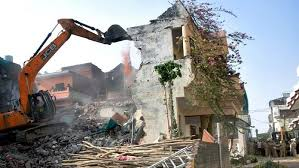
Imagine walking into your home one morning and seeing bulldozers tearing down your property, all in the name of “law and order.” For many Indians, such instances are not just hypothetical—they’ve become a stark reality in cities like Delhi, Prayagraj, and elsewhere. This phenomenon, popularly termed “bulldozer justice,” raises critical questions: Does swift action against alleged offenders bypass fundamental rights? How does it align with the rule of law, which is supposed to guarantee equality, liberty, and due process?
In this article, we will critically examine bulldozer justice from a legal-analytical perspective, exploring how it interacts with Articles 14, 19, 21 of the Indian Constitution, judicial precedents, and the broader framework of due process.
Understanding Bulldozer Justice
Bulldozer justice refers to the rapid demolition of properties—often without prior notice, opportunity for hearing, or legal recourse—allegedly belonging to individuals accused of criminal acts or law violations. Though presented as an efficient tool for enforcing law, it raises serious concerns:
- Selective targeting: Often seen in minority neighborhoods or politically sensitive areas.
- Extra-judicial enforcement: Actions executed without court orders or adequate legal safeguards.
- Public spectacle: Sometimes carried out as a warning or deterrent, amplifying social anxiety.
Why the Legal Lens Matters
India is a constitutional democracy, and the state’s power is limited by fundamental rights. Actions that bypass due process—even in the name of efficiency—challenge the very principles enshrined in the Constitution. The judiciary has consistently emphasized that no individual is above the law, and no action should be arbitrary.
Key takeaway: Bulldozer justice may seem effective on the surface, but legal scrutiny exposes potential violations of fundamental rights and procedural fairness.
Article 14 and the Principle of Equality
Article 14 of the Indian Constitution guarantees equality before the law and equal protection of the laws. Its core principle is that similar cases must be treated alike, and no person should face arbitrary discrimination.
Arbitrary Action vs. Reasoned Decision
Bulldozer operations often lack uniformity. For instance:
- Two properties violating similar regulations may face different treatment.
- Minor infractions in politically neutral areas may go unpunished, while some neighborhoods face disproportionate action.
Judicial precedents reinforce this:
- E.P. Royappa v. State of Tamil Nadu (1974): The Supreme Court emphasized that arbitrariness is antithetical to equality under Article 14.
- Maneka Gandhi v. Union of India (1978): Expanded the scope of Article 14 to include fairness in administrative actions.
Practical Insight: Any demolition without clear, uniform criteria risks being arbitrary and unconstitutional, potentially inviting judicial review.
Key takeaway: Equality under Article 14 demands that bulldozer actions follow consistent legal standards, not political expediency.
Article 19 and the Right to Property Use
Article 19(1)(g) guarantees citizens the right to practice any profession or carry on any occupation, trade, or business, which extends to using property lawfully. Although the Right to Property is now a legal right under Article 300A, demolitions without due process can affect livelihoods and businesses.
Legal Boundaries for Demolitions
- State authorities can only interfere after following lawful procedures.
- Notice and opportunity to be heard are non-negotiable under procedural law.
- Arbitrary demolitions can affect not only residential properties but also shops, offices, and factories, impacting economic freedoms.
Example: In some cases in Delhi, businesses were demolished allegedly for irregularities without prior warning, affecting employees and economic activity.
Key takeaway: Respecting Article 19 and property rights ensures that law enforcement does not turn into arbitrary expropriation, safeguarding both individual and community interests.
Article 21 and the Right to Life and Personal Liberty
Article 21 is the cornerstone of human rights in India, guaranteeing protection of life and personal liberty. Courts have interpreted it broadly to include dignity, livelihood, shelter, and procedural fairness.
How Bulldozer Justice Clashes with Article 21
- Violation of procedural fairness: Rapid demolitions deny the affected individuals a hearing, violating natural justice principles.
- Impact on livelihood: Destroying shops, workshops, or homes affects families’ ability to survive.
- Psychological distress: Such actions often occur publicly, causing humiliation and trauma.
Judicial Perspective:
- Olga Tellis v. Bombay Municipal Corporation (1985): The Supreme Court recognized the right to livelihood as part of Article 21.
- Sampath Kumar v. Union of India (1987): Demolition without proper notice or rehabilitation is arbitrary and illegal.
Practical Insight: Any state action impacting life, liberty, or property must balance law enforcement with fundamental rights. Bulldozer justice often fails this balance.
Key takeaway: Article 21 demands procedural fairness and proportionality, which cannot be bypassed even in “swift justice” scenarios.
Due Process and Judicial Oversight
Though India does not have a formal due process clause like the United States, the Supreme Court has consistently held that procedural fairness is integral to Articles 14 and 21.
Due Process Principles in Context
- Notice: Citizens must be informed before any adverse action.
- Hearing: Opportunity to contest allegations is mandatory.
- Proportionality: Action should be appropriate to the violation.
- Judicial Review: Courts must have the authority to check executive excesses.
Case Study: Jahangirpuri Demolitions
In April 2023, several homes were demolished in Delhi’s Jahangirpuri area:
- Issue: Alleged illegal construction and rioting.
- Legal concern: Many residents claimed no prior notice or opportunity to present documents.
- Judicial angle: Courts later intervened, underscoring the need for due process even in communal or political contexts.
Key takeaway: Due process acts as a check against arbitrary state power, ensuring that law enforcement does not trample constitutional rights.
Judicial Precedents on Arbitrary Demolition
The Supreme Court and High Courts have repeatedly struck down demolitions carried out without procedural compliance:
- Sampath Kumar v. Union of India (1987): Demolition without notice violates natural justice.
- Olga Tellis v. BMC (1985): Eviction must consider the right to livelihood.
- Maneka Gandhi v. Union of India (1978): Expanded procedural safeguards in administrative actions.
H3: Lesson for Authorities
- Transparency, notice, and fairness are non-negotiable.
- Public spectacle as a deterrent cannot replace constitutional safeguards.
- Arbitrary actions can invite judicial intervention and reputational costs.
International Perspective
Even globally, extra-judicial demolitions are frowned upon:
- United States: Due process is enshrined in the Fifth and Fourteenth Amendments; property cannot be seized arbitrarily.
- European Union: Human rights frameworks require notice, proportionality, and judicial review.
India, as a democracy, is expected to adhere to similar standards, blending enforcement with constitutional respect.
Key takeaway: India’s constitutional framework is aligned with global human rights norms, emphasizing fairness over spectacle.
Common Mistakes in Implementing Law Enforcement
- Ignoring legal notices: Authorities sometimes skip issuing prior notices.
- Publicizing action for intimidation: Turns enforcement into political messaging.
- Selective targeting: Violates Article 14.
- Failure to rehabilitate: Demolitions without compensation or alternatives affect livelihoods.
Practical Tip: Legal authorities should always document reasons, provide notice, and ensure proportionality, minimizing the risk of judicial reversal.
Balancing Law and Rights: The Way Forward
- Standard Operating Procedures (SOPs): Clear guidelines for enforcement actions.
- Pre-approval from courts: Especially in sensitive areas.
- Community engagement: Avoid public humiliation; focus on lawful compliance.
- Training for officials: Emphasize constitutional literacy and human rights.
Key takeaway: Rule of law is not weakened by enforcement—it is strengthened when rights and responsibilities coexist.
Conclusion
Bulldozer justice may offer an illusion of swift action, but it carries profound constitutional risks. Articles 14, 19, and 21, along with judicial precedents, insist on equality, fairness, and due process. Any deviation undermines the rule of law, potentially turning enforcement into arbitrary power.
For a democracy like India, the challenge is clear: uphold law without violating rights, enforce regulations without bypassing procedure, and maintain public trust without political spectacle.