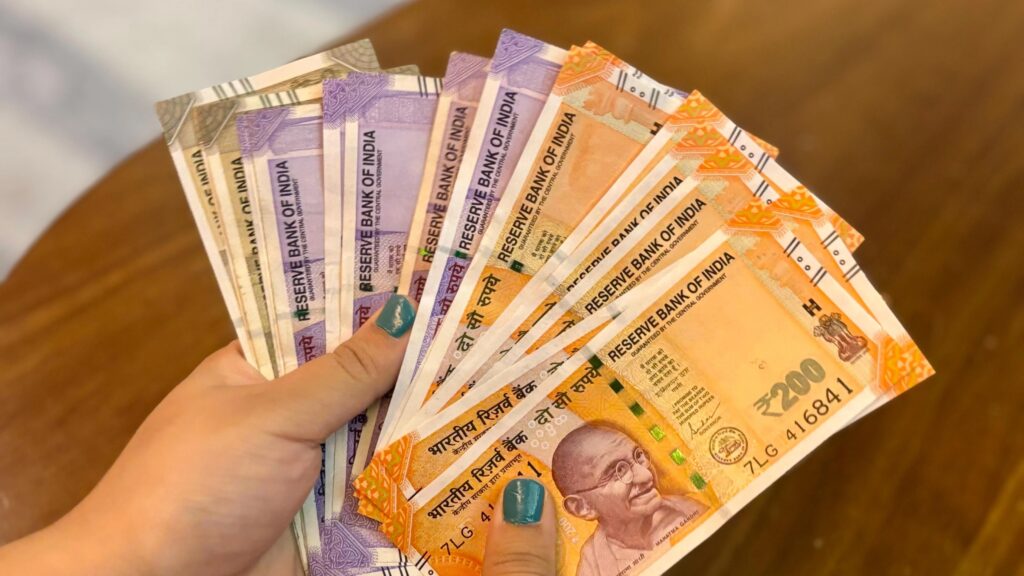
Rupee Declines 4 Paise Against US Dollar
The Indian rupee declined 4 paise to close at 90.21 (provisional) against the US dollar on Tuesday, weighed down by higher crude oil prices, a firm American currency, and incessant outflow of foreign funds. Analysts said geopolitical tensions and weak equity markets also put pressure on the Indian currency.
At the interbank foreign exchange, the rupee opened at 90.24 and touched the intra-day low of 90.30 against the greenback. The currency ended the session at 90.21 (provisional) against the dollar, down 4 paise from its previous close.
Factors Affecting the Rupee
Anuj Choudhary, Research Analyst at Mirae Asset ShareKhan, said the rupee declined amid ongoing geopolitical tensions and global risk aversion. Weak domestic markets, FII outflows, and a surge in crude oil prices also pressurized the rupee.
However, optimism on the India-US trade deal and rising odds of a rate cut amid weak labour market reports last week may support the rupee at lower levels. Any intervention by the central bank may also support the rupee. Traders are now focusing on US inflation data. USD-INR spot price is expected to trade in a range of 90.10 to 90.70.
Impact on Indian Investors
The decline in the rupee’s value can have a significant impact on Indian investors, particularly those who invest in US stocks or have exposure to international markets. A weaker rupee can make imports more expensive, which can lead to higher prices for consumers.
However, a weaker rupee can also make Indian exports more competitive, which can boost the country’s trade balance. Indian investors who invest in export-oriented stocks may benefit from a weaker rupee.
Market Sentiment
Market sentiment improved after the new US envoy to India, Sergio Gor, on Monday said that both sides are actively engaged in firming up a trade deal, forex analysts said.
Meanwhile, the dollar index, which measures the greenback’s strength against a basket of six currencies, was trading 0.07% higher at 98.69.
Brent crude, the global oil benchmark, was trading 1.47% higher at $64.80 per barrel in futures trade.
Domestic Equity Market
On the domestic equity market front, the 30-share benchmark index Sensex lost 250.48 points or 0.30% to settle at 83,627.69, while the Nifty fell 57.95 points or 0.22% to 25,732.30.
Foreign institutional investors offloaded equities worth Rs 3,638.40 crore on Monday, according to exchange data.
Economic Data
According to government data released on Monday, India’s retail inflation rose to a three-month high of 1.33% in December, mainly due to higher food prices, but remained below the Reserve Bank of India’s lower tolerance level.
Also, the latest data from the Income Tax Department showed the government’s net direct tax collection grew about 8.82% to over Rs 18.38 lakh crore in the current fiscal till January 11 due to slower refunds and better corporate tax mop-up.
Net corporate tax collection grew 12.4% to over Rs 8.63 lakh crore, and taxes from non-corporates, including individuals, rose 6.39% to about Rs 9.30 lakh crore.
Conclusion
In conclusion, the rupee’s decline against the US dollar can have a significant impact on Indian investors. While a weaker rupee can make imports more expensive, it can also make Indian exports more competitive. Indian investors who invest in export-oriented stocks may benefit from a weaker rupee.
It is essential for Indian investors to stay up-to-date with the latest market news and trends to make informed investment decisions. By following the latest market news and staying informed about the factors that affect the rupee’s value, Indian investors can navigate the complex world of international trade and investment.